William Henry Jackson
1843 – 1942
The survey photographer whose images of Yellowstone helped create the first national park
William Henry Jackson was born on April 4, 1843, in Keeseville, New York, a village in the Adirondacks near Lake Champlain. He showed an early talent for drawing and watercolor, skills he developed as a teenage retouching artist and colorist in photography studios in Troy, New York, and later in Rutland, Vermont. In October 1862 he enlisted as a private in Company K of the 12th Vermont Infantry, serving a nine-month term during the Civil War that included duty around the Battle of Gettysburg before he mustered out in 1863.
After a broken engagement, Jackson headed west in 1866, traveling as a bullwhacker on wagon trains and working briefly along the overland routes. In 1867 he settled in Omaha, Nebraska, where he and his brother Edward opened a photographic studio. Working from this base, Jackson photographed local Native American subjects and, in 1869, secured a commission to make scenic views along the newly completed Union Pacific Railroad, producing the railroad landscapes that first established his reputation.
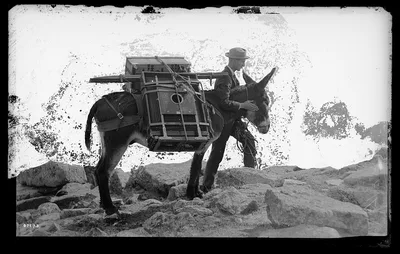
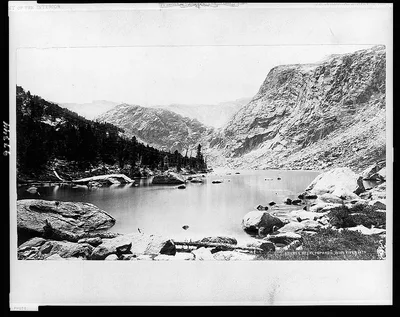
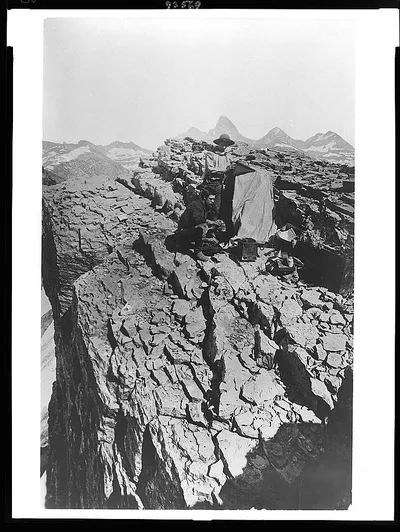
This railroad work brought Jackson to the attention of Ferdinand Vandeveer Hayden, the geologist directing the federal survey of the western territories. In 1870 Jackson joined the Hayden Geological Survey as its official photographer, beginning an association that lasted through 1878. The 1871 expedition to the Yellowstone region was the turning point of his career: hauling a portable darkroom and heavy glass-plate equipment by mule, he made the first widely circulated photographs of the area's geysers, hot springs, and canyons.
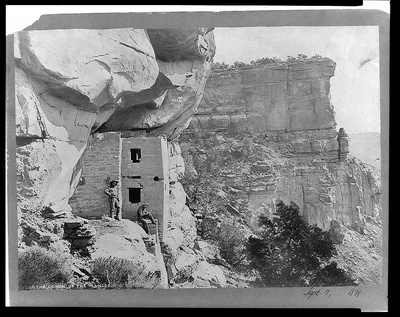
Jackson's 1871 Yellowstone photographs, shown to members of Congress alongside the paintings of the artist Thomas Moran, who had accompanied the same expedition, provided visual evidence of the region's wonders. In March 1872 Congress passed and President Ulysses S. Grant signed the act establishing Yellowstone as the first national park. Jackson continued with the survey, photographing the Colorado Rockies, including the snow-filled ravine of the Mount of the Holy Cross in 1873, and in 1874 making the first photographs of the Ancestral Puebloan cliff dwellings in the Mancos Canyon of the Mesa Verde region.
After the surveys ended, Jackson opened a commercial studio in Denver in 1879 and built a thriving business in large-format views of the Rocky Mountain West, railroads, and mining towns. From 1894 to 1896 he traveled the globe as a photographer for the World's Transportation Commission, documenting railways and transport across Asia, North Africa, and Australia.
In 1897 Jackson sold his enormous stock of negatives to the Detroit Photographic Company (later the Detroit Publishing Company) and the following year became a partner and director of the firm. The company mass-produced color views and postcards using the Photochrom process, distributing Jackson's western images to a national audience until financial troubles led to its decline in the 1920s. In his later years Jackson moved to Washington, D.C., painted murals for the Department of the Interior, served as a consultant on western scenes, and in 1940, at the age of ninety-seven, published his autobiography, Time Exposure. He died on June 30, 1942, in New York City at the age of ninety-nine and was buried in Arlington National Cemetery.
A Career in Images
![[Henry F. Edwards, head-and-shoulders portrait, facing slightly left], 1865](/static/images/2022676955_thumb.webp)
![[Three men in gulch with a sluice, placer mining for gold], 1872](/static/images/95514201_thumb.webp)