The Tetons and the Snake River (1942)
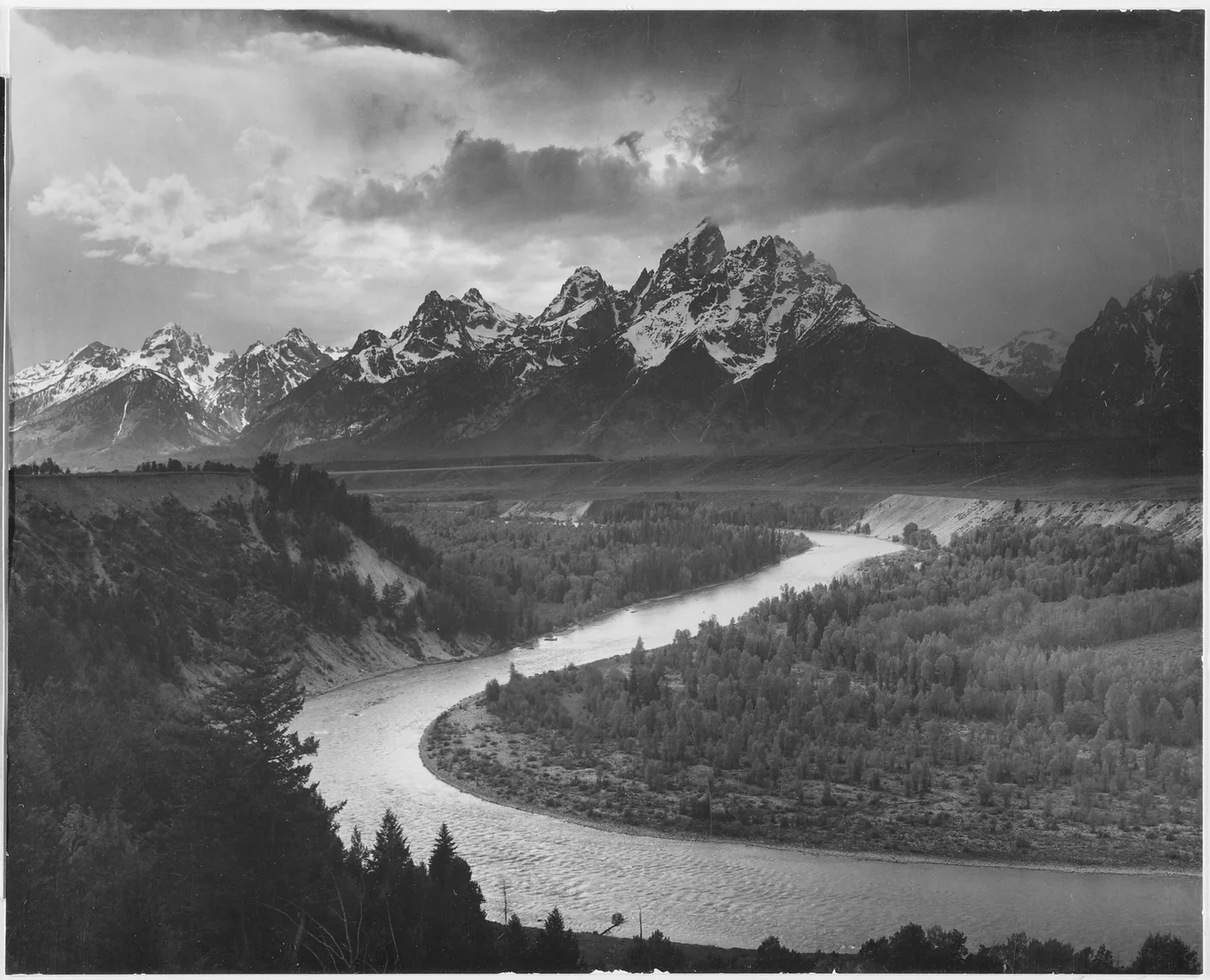
The Snake River curves through the valley below the Teton Range in Grand Teton National Park, Wyoming. Ansel Adams made the photograph in 1942 for the Department of the Interior's Mural Project, and the original print is held by the National Archives. Because it was made for the federal government, it is in the public domain.
- Date
- 1942
- Photographer
- Ansel Adams (1902–1984), for the Department of the Interior Mural Project
- Location
- Grand Teton National Park, Wyoming, near today's Snake River Overlook
- Collection
- National Archives, Records of the National Park Service (Record Group 79), 79-AAG-1
- Also known as
- "The Tetons - Snake River," Grand Teton National Park, Wyoming; Ansel Adams Tetons and Snake River; Snake River and Grand Tetons
The Mural Project
In the mid-1930s Secretary of the Interior Harold Ickes planned murals for the department's headquarters building in Washington. The idea later grew into a set of mural-size photographs, and in 1941 the National Park Service commissioned Ansel Adams to make them. The theme, in the National Archives' words, was nature as exemplified and protected in the U.S. National Parks.
Adams was appointed at the maximum pay then allowed for a position that did not need congressional approval: twenty-two dollars and twenty-two cents a day, for no more than 180 days of work a year. He began traveling to the parks in October 1941 and delivered his prints to the department about a year later. His itinerary included Grand Canyon, Grand Teton, Kings Canyon, Mesa Verde, Rocky Mountain, Yellowstone, Yosemite, Glacier, Zion and Carlsbad Caverns, along with monuments and other sites in the Southwest. The project was halted during World War II and never resumed.
What the photograph shows
The Snake River winds through the foreground and middle distance in a broad curve, catching the light against darker banks of trees. Beyond it the Teton Range rises above the valley under heavy clouds. The river leads the eye back toward the mountains, and the deep tonal range, from black shadow to bright water and snow, is typical of the large prints Adams made for the project.
A National Park Service historic resource study of Grand Teton calls it the climax vision of the park and reads it as an image of untouched nature. The same study notes that the picture was made in a rainstorm.
Where Adams stood
The National Park Service marks the Snake River Overlook as roughly the vantage point from which Adams made the photograph. The Park Service also notes that the exact spot is not known and that trees have grown since 1942, so the view from the overlook today does not match his frame.
Why it is in the public domain
Adams made the Mural Project photographs while employed by the Department of the Interior. In an August 1942 letter he stated that the photographs were the property of the U.S. Government. The National Archives, which accessioned the original prints in 1962, says the photographs in series 79-AA have no copyright restrictions and may be used without permission. Adams kept the negatives, which are now at the Center for Creative Photography at the University of Arizona.
This is different from most of Adams's work. His best-known independent photographs, such as Moonrise, Hernandez, New Mexico, Monolith, the Face of Half Dome and Clearing Winter Storm, were not made for the government, are not National Archives records and are not part of this archive.
Voyager and later fame
When NASA launched the two Voyager spacecraft in 1977, each carried a gold-plated record of sounds and images from Earth, assembled by a committee chaired by Carl Sagan. NASA's list of images on the Golden Record includes "Snake River and Grand Tetons, Ansel Adams," and another Adams photograph, the Golden Gate Bridge, is also on the record.
The Department of the Interior finally installed 26 of the Mural Project photographs as murals in its headquarters in 2010, in an exhibit titled Ansel Adams: The Mural Project 1941–1942. Museums including the National Gallery of Art hold later prints from the 1942 negative.
The version in this archive
This archive holds the National Archives print catalogued as "The Tetons - Snake River," Grand Teton National Park, Wyoming, local identifier 79-AAG-1, from the series Ansel Adams Photographs of National Parks and Monuments. The title follows the original caption on the print. It is one of 220 Mural Project photographs on this site; the full set can be browsed on the Ansel Adams subject page.
Frequently asked questions
When did Ansel Adams take The Tetons and the Snake River?
In 1942, while working on the Department of the Interior's Mural Project, which the National Park Service commissioned in 1941.
Is Ansel Adams's Tetons and Snake River photograph in the public domain?
Yes. Adams made it for the federal government, and the National Archives says the photographs in its Mural Project series have no copyright restrictions and may be used without permission. Most of Adams's other famous photographs were not made for the government and are not public domain.
Where did Ansel Adams take The Tetons and the Snake River?
In Grand Teton National Park, Wyoming. The National Park Service identifies the Snake River Overlook as roughly his vantage point, though the exact spot is not known and trees have since grown in front of the view.
Is The Tetons and the Snake River on the Voyager Golden Record?
Yes. NASA's list of images on the Golden Record, carried by both Voyager spacecraft launched in 1977, includes "Snake River and Grand Tetons, Ansel Adams."
Where is the original print?
The National Archives at College Park, Maryland, holds the original Mural Project print, National Archives Identifier 519904. Adams kept the negative, which is now at the Center for Creative Photography in Tucson.
Sources
- "The Tetons - Snake River," Grand Teton National Park, Wyoming (National Archives Catalog)
- "The Tetons - Snake River," Grand Teton National Park, Wyoming, 1942 (National Archives, Still Picture highlights)
- Ansel Adams Photographs (National Archives)
- 79-AA: Ansel Adams Photographs of National Parks and Monuments, 1941–1942 (National Archives, The Unwritten Record)
- Images on the Golden Record (NASA)
- Snake River Overlook (National Park Service)
- Grand Teton National Park Historic Resource Study, Chapter 18 (National Park Service, via NPS History)